
How Much Should a PVS-14 Cost?
Quick rundown. Not an all encompassing guide, do your research.
The short answer
A working PVS-14 costs roughly $1,100 to $4,500 in 2026.
There. That's your answer. Not very useful without an explanation.
As with most night vision, a good chunk of that total cost comes from the image intensifier tube inside of it. A hand-built unit on a graded Gen 3 surplus tube runs about $1,100 to $2,200, a new commercial Gen 2+ build lands around $1,700 to $2,300, while a new white phosphor Gen 3 from L3Harris or Elbit runs $2,800 to $4,500. Auxiliary components are a smaller, stable part of the equation. The image intensifier tube itself is where things get interesting.
Now the caveat. There is no fixed price for any night vision component, and there never will be. This space is niche and temperamental, and rarely does anything stay concrete for long.
That's not to say guessing and praying is the buyer's strategy either. Anybody worth their salt, buyer and seller alike, knows three things before money moves: What it's worth, what it should be worth, and whether or not it is a good fit for them. That last point is the goal, and by the end of this article you will hopefully be able to discern a well fitting unit for your situation from a device not worth your time.
What a PVS-14 actually is
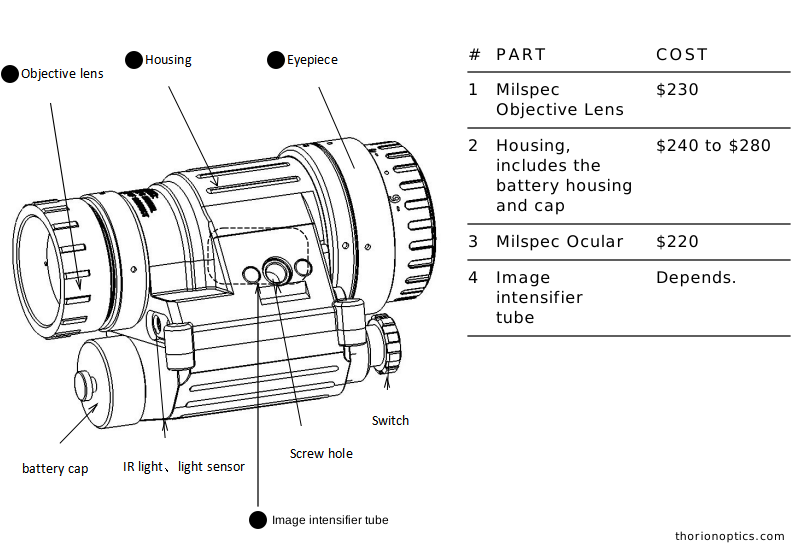
If you said the best monocular of all time, you'd be about half right. PVS-14 is a platform name designated by the U.S. Army. It takes MX-11769 and MX-10160 footprint tubes, PVS-14 compatible glass and components, and without an image intensifier tube is a useless hunk of plastic.
That plastic is cheap. A polymer PVS-14 housing runs about $240 to $280 retail, and less to make. Its only job is to hold the optical train inline with a multi-thousand dollar image intensifier tube in the right spot and keep it safe from the elements.
So if the housing is so cheap, why does a functional unit cost thousands?
Because America. No, seriously, It's because of America.
Why image intensifier tubes cost what they do
Almost every modern Gen 3 tube is made by one of two U.S. defense contractors: Elbit America and L3Harris. They produce the best image intensifiers in the world through decades of research and manufacturing standards written for the military, not for you. That comes at a cost.
Four main factors keep the cost high.
Yield: not every tube that comes off the line is usable, and the good ones carry the cost of the duds.
Complexity: Image intensifier tubes are incredibly complex and difficult to manufacture, which all equates to $$$. You can read more about how IIT's are manufactured here (Not linked yet)
Demand: the primary customer is the Department of Defense, and big players have little incentive to sell to civilians
Export control: Gen 3 tubes are ITAR regulated, so the manufacturers can't chase volume overseas and every tube for the military has to be manufactured right here in the U.S.A
There are two main ways around this high cost. One is a overseas commercial Gen 2+ tube, mostly from Photonis in Europe and NNVT in China, which sidesteps the U.S. duopoly at the cost of performance. The other is surplus: Gen 3 tubes that have cycled out of military and law enforcement service, or that carry blemishes a contract wouldn't accept. Surplus is where most of the price drop in this article comes from, and it's what I build with.
What a PVS-14 costs in 2026
These are finished-unit prices: a new milspec housing and glass plus the tube, assembled and working. Not a bill of materials.
| Tier | What's inside | Built unit, 2026 |
| Gen 3 surplus, hand-built | Surplus L3Harris or Elbit Gen 3 tube, graded for condition | $1,100 to $2,200 |
| Commercial Gen 2+ | New Photonis Gen 2+ tube | $1,700 to $2,300 |
| New Gen 3 white phosphor | New L3Harris or Elbit, milspec or high-end commercial | $2,800 to $4,500 |
The surplus band is the widest because condition varies the most. A clean surplus tube with low hours sits near the top of it. A tube with nasty blemishes or questionable origins sits near the bottom. The housing and glass move the needle too, but by hundreds, not thousands.
The Gen 2+ band is where new-tube buying starts. Chinese NNVT tubes also show up here, usually cheaper than Photonis. With NNVT, the spec sheets can be inconsistent (Sometimes made up) and the community's track record with them is poor. If a Gen 2+ unit looks unusually cheap, check the tube origin before you check anything else.
The top band is new thin-filmed (or filmless if you can get it) white phosphor Gen 3 at full price. It dips below $2,800 only on blemished units and the occasional unicorn deal, and those get bought within hours.
What moves the price
Two tubes from the same factory can be hundreds of dollars apart. Here's what decides where a unit lands.
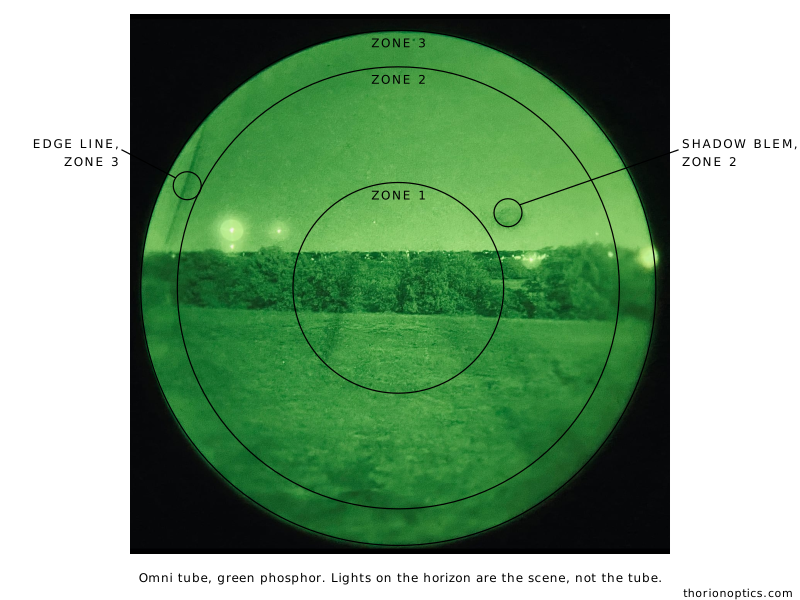
- Grade and blemishes. Where the spots are matters more than how many. A blem in zone 3 discounts very little. The same blem in the center of the image costs the seller hundreds.
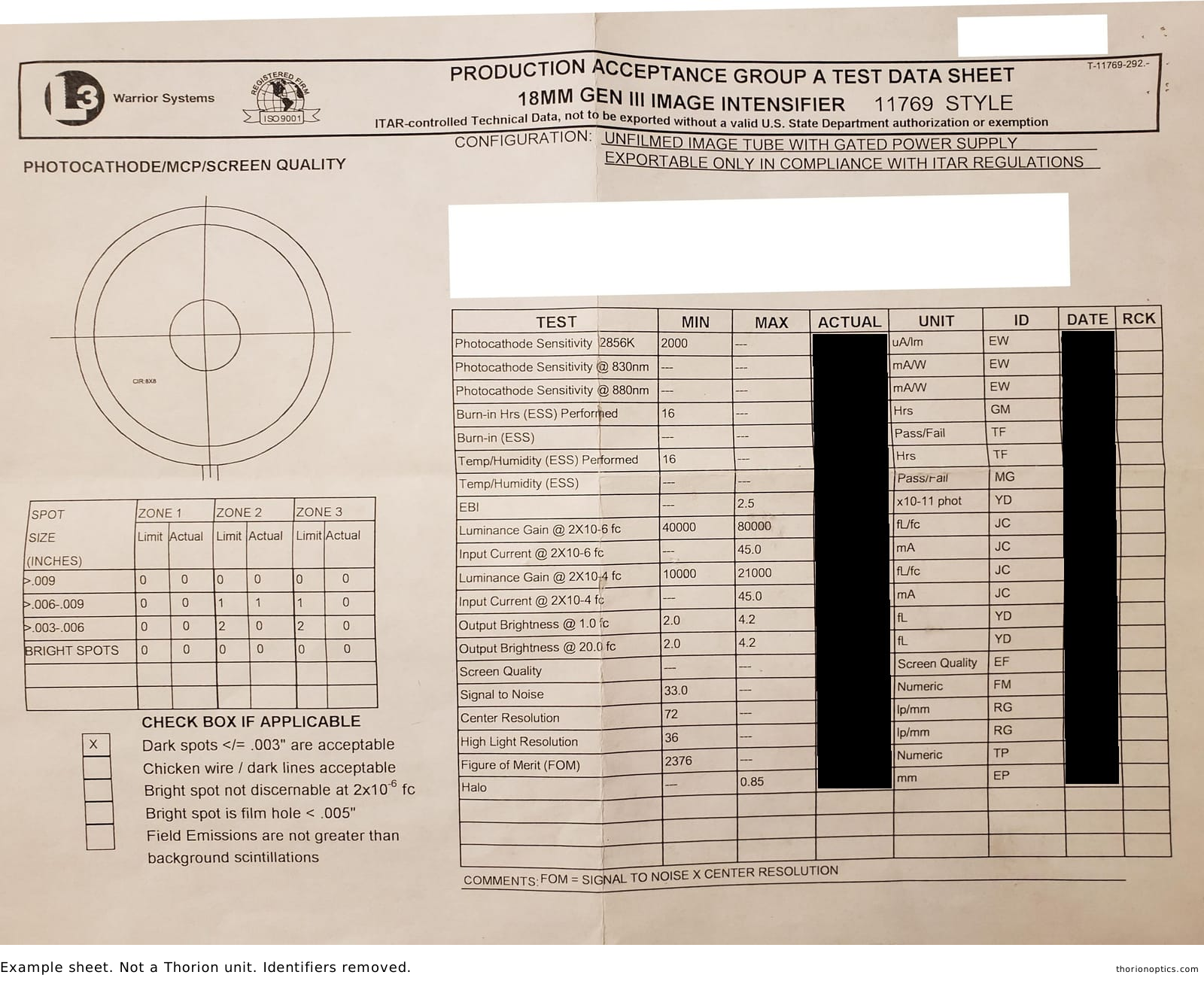
- Spec sheet. Figure of Merit, signal-to-noise and resolution set the tubes baseline value. A tube with paperwork on the secondhand market sells for more than the same tube without it, because the tubes origin and performance are verifiable.
- Phosphor color. White phosphor commands a premium over green on new tubes. On surplus the gap narrows, because surplus is mostly green and the buyer is paying for condition first.
- Filmed vs. unfilmed. Unfilmed and thin-filmed tubes carry a premium for lower halo and better low-light performance. Most surplus is thin-filmed.
- Housing and glass. A new milspec housing with high performing glass adds $600 to $850 over a used housing.
- Warranty and seller. A tube with a written warranty from a seller who publishes their sold prices costs more than the same tube from a username on a forum. That gap is the price of recourse. Whether it's worth paying is up to you, but it's real and valuable.
Prices in this hobby are set by proof and condition, in that order. A seller who can't tell you what they have in hand is pricing on hope. A seller that refuses to show proof of their possession of a unit is not a seller at all; be weary when buying anything expensive let alone night vison.
Where these numbers come from
Every unit I've sold stays on the builds page with its final price, tube contract, grade and photos. That's the dataset behind the surplus band above, and it's the only one I know of in this space that's public and easy to access.
The Gen 2+ and new Gen 3 bands are retail figures from manufacturer and dealer pricing, not my sales. I build on surplus, so take those two rows as a market reference rather than a Thorion quote.
Who this is for
This article is for the buyer who knows what they want but not what it'll cost to get it. If that's you: budget $1,400 to $2,100 for a hand-built surplus Gen 3, do your research before jumping on a unit, and don't overpay if you can help it.
The manufacturers, contracts and tiers of image intensifier tubes were left out on purpose. That's its own article for a different day. Until then, the builds page shows what's on the bench and what's already sold, and the custom build form is where to start if nothing there fits.
If you take away only one thing from this article today, let it be this: Stay curious.
If you have any questions or concerns feel free to contact me via form or email.
Till next time,
Nathan
Working notes from the bench, filed as builds come through. North Texas.
Back to Articles© 2026 Thorion Optics. Quote freely with a link back; do not republish in full.